Doctor of Philosophy
The Ph.D. degree in computer science is offered through the computer science graduate program. Requirements include 90 semester hours of graduate-level credit. All work must be completed within seven years.
General requirements include completing the breadth requirement and passing the Research Proficiency Exam (preliminary examination); successfully presenting a research plan to one’s supervisory committee at a research proposal meeting; and completing the research plan, writing a dissertation and successfully defending the dissertation in an open forum.
General requirements
- Completing the Breadth Requirement
- Passing the Research Proficiency Exam (RPE)
- Passing the Preliminary Examination
- Completing a Proposal Defense
- Writing a dissertation and successfully defending the dissertation in an open forum.
Coursework requirements
- 24 hours of course credit at Kansas State University beyond the master’s degree level
- 15 hours must be 800 level or above
- One or more courses in theoretical or fundamental topics
- At least 30 hours of Ph.D. research credit.
Refer to the Ph.D. Handbook below for more detailed requirements.
Resources
Electronic form submission – This takes you to the Graduate school's form submission links. There are separate submission links for each form and detailed instructions on how to complete them.
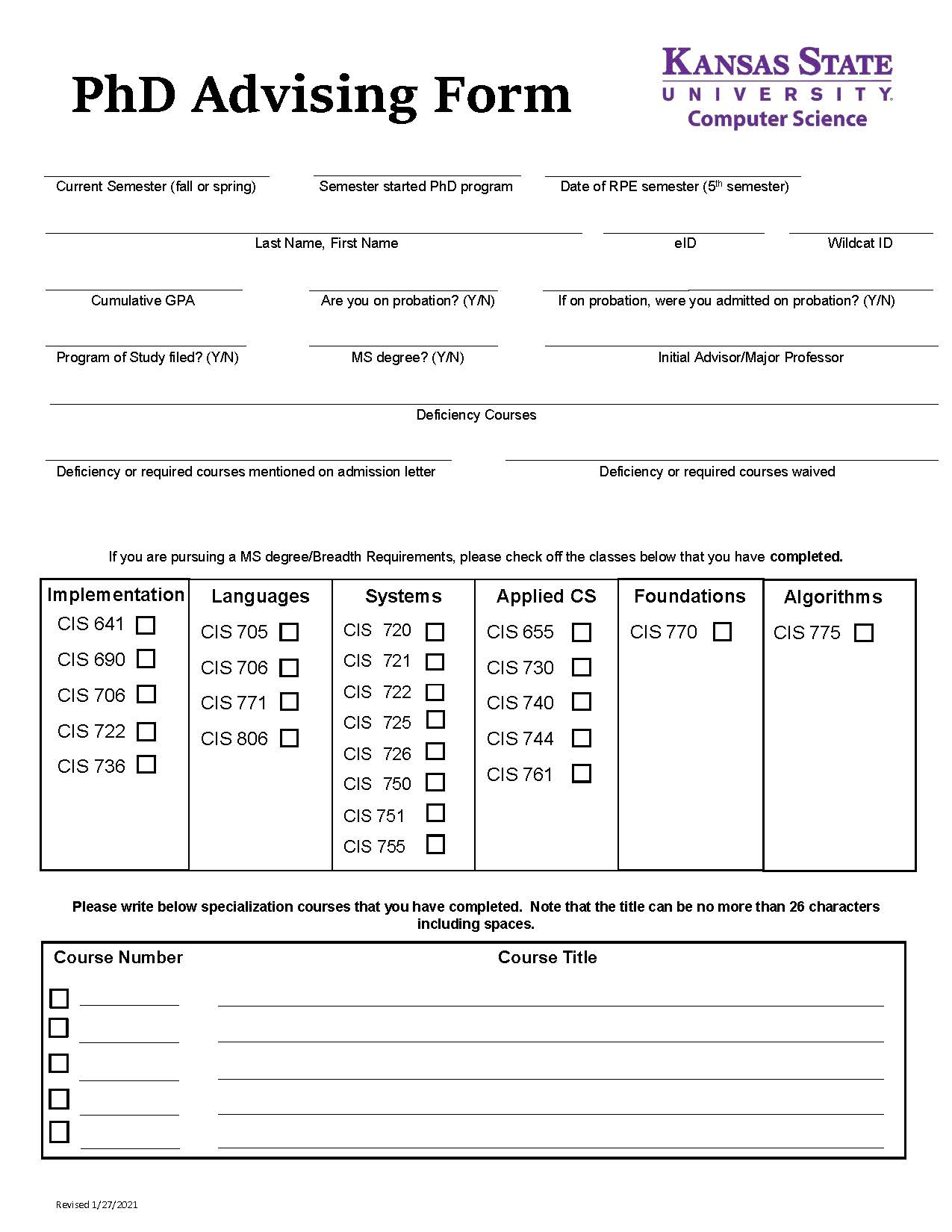
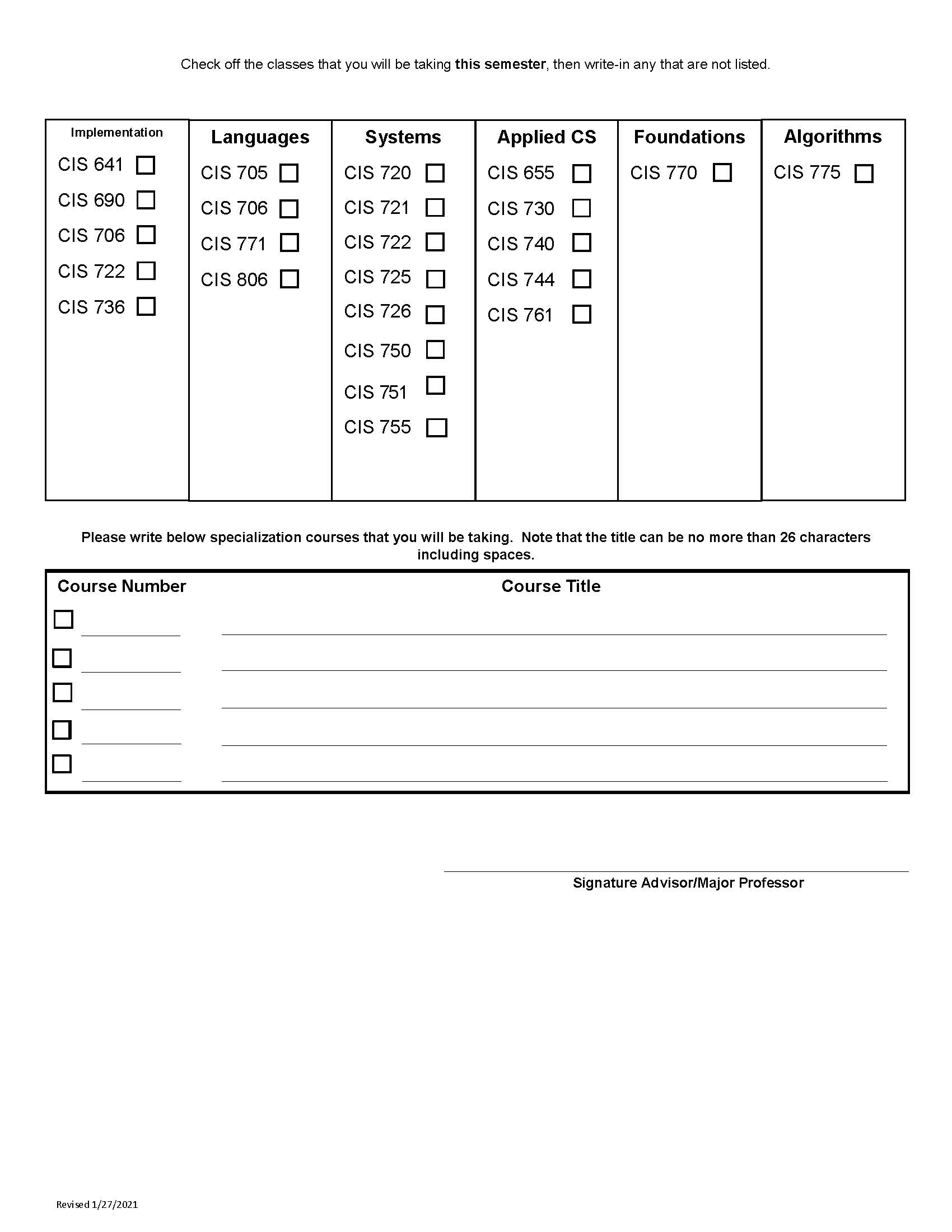
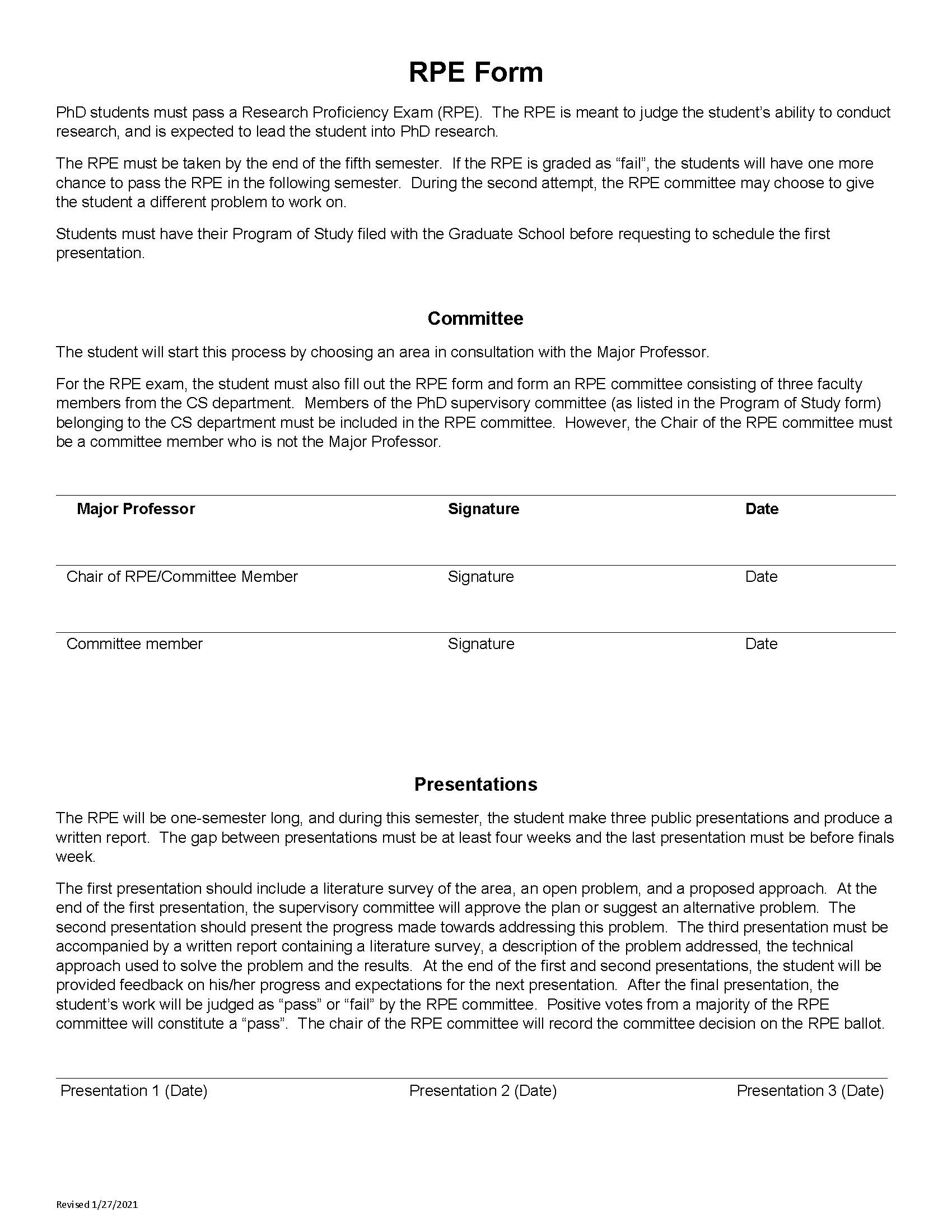
Ph.D. advising form with RPE form (pdf)
Ph.D. Handbook (Updated for Fall 2026)
- This document describes requirements and standards defined by Kansas State University and by the Department of Computer Science for the degree of Doctor of Philosophy in Computer Science. All students are expected to meet these standards. If any exceptions to the requirements are warranted, the student may petition their Supervisory Committee and the Graduate Studies Committee, who must approve and support those exceptions by signing a written statement that defines alternate requirements.
- General rules for graduate studies at Kansas State University are described in the “Graduate Handbook” which is available on the Graduate School web page.
- A strong background in computer science is normally required for admission. Evidence of this background should include either:
- a Bachelor’s or Master’s degree in computer science (or a closely related field though exceptional candidates with degrees in other areas will also be considered) from an ABET-accredited institution in the United States, with a GPA of at least 3.0 (though 3.5 is recommended) for the Bachelor’s degree or of at least 3.5 for the Master’s degree, or
- a degree from an institution outside the United States that is comparable to a US degree as mentioned above, along with Graduate Record Examination (GRE) scores which should be at least 146 Verbal, 151 Quantitative, 3.0 Analytical Writing (though 150 Verbal, 160 Quantitative, 3.5 Analytical Writing is recommended).
- International students who received their degree(s) abroad must take a language test approved by the university, typically the International English Language Testing System (IELTS), where a score of at least 6.5 is required. Applicants from certain English-speaking countries are exempt from this requirement.
- All qualifications taken as a whole must give evidence of a potential to conduct scholarly research. Besides the qualifications listed above, additional qualifications might include the strength of prior training, and/or published research.
- The PhD degree requirements include 90 credit hours of graduate-level credit, typically distributed as:
- 30 credit hours of Master’s level coursework,
- 24-30 credit hours of PhD level coursework (at least 15 hours of which must be at the 800 or 900 level),
- 30-36 credit hours of research culminating in a PhD dissertation (see Section 10).
- Students may take up to 12 credit hours of graduate coursework from another department, but may not use any 500-level courses within the computer science department for graduate credit.
- International students may have attendance requirements to maintain their immigration status.
- Students must maintain a grade point average of at least 3.0 in all coursework.
- Students must make regular progress toward completion of the PhD degree.
- If a student is employed by the Department of Computer Science, they must enroll for at least 6 hours of graduate-level credit each Fall and Spring term of employment.
- International students must, if they hold a GTA position, have a score of 7 or better on the Speaking section of the IELTS (or similar scores for the speaking sections of other approved language tests).
- PhD students are expected to participate in the professional activities of the Department of Computer Science. They should attend seminars and research group presentations offered by the department and by the professional societies within the department.
- Upon admission to the PhD program, the student will be assigned a faculty member to serve as an academic advisor, who will help the student select courses, and who will review the student’s progress until a major professor is selected.
- By the end of the first year of PhD studies, the student should select and be accepted by a major professor who must be a member of the Graduate Faculty in the Department of Computer Science. (The initially-assigned academic advisor may serve as the Major Professor.)
- Because the Major Professor will organize and direct all research, students should choose him/her carefully.
- Faculty members are not obligated to accept every student who asks them to be their Major Professor.
- Also, a faculty member may impose further requirements before agreeing to serve as the Major Professor.
- In consultation with the Major Professor, students must compose a Supervisory Committee. The Major Professor is the Chair of the Supervisory Committee, which must include at least three additional members. Two of these additional members must be chosen from the Graduate Faculty in the Department of Computer Science at Kansas State University. The third additional member must be chosen from outside of the Department of Computer Science, but must be a member of the Graduate Faculty at Kansas State University. All committee members must be chosen so their area of expertise is relevant to the dissertation research the student proposes to do.
- Students should consult regularly with their Major Professor.
- The student must meet with the members of their Supervisory Committee and formulate a Program of Study which must be filed with the Graduate School within one year of starting the program.
- The Program of Study contains the following information:
- Name of the Major Professor
- Names of all members of the Supervisory Committee
- Proposed title of dissertation
- List of graduate credits taken and to be taken (totaling at least 90 hours), including the following:
- Graduate courses taken at other universities which have been transferred (all transfer credit is subject to the approval of the Graduate Studies Committee, the student’s Supervisory Committee, and the Graduate School); up to 30 credit hours from a Master’s degree, and up to 10 credit hours of other graduate credit, may be transferred;
- Credit hours already taken at Kansas State University towards the PhD degree;
- Credit hours to be taken at Kansas State University towards the PhD degree;
- Any additional requirements imposed by the student’s Supervisory Committee (such as English 516, “Written Communication for the Sciences”, for a supplemental writing experience).
- Students should not enroll in CIS 999, PhD Research, until a Program of Study has been approved by the Graduate School.
- The following credit requirements shall be observed:
- 24 credit hours at Kansas State University beyond the master’s degree level, of which
- 15 hours must be 800 level or above (includes, but not limited to, CIS 890 and CIS 990);
- in addition, at least 30 hours of Ph.D. research credits (CIS 999).
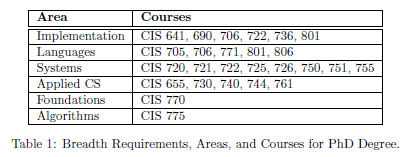
The Breadth Requirements are fulfilled by coursework demonstrating proficiency in six different areas, as described below and in Table 1. NOTE: Although the same course may appear in different areas in the lists below, no one course may be used to satisfy the requirement for more than a single area. NOTE: courses in parentheses have not been offered recently.
- One course from the following list, with a deep emphasis on Implementation: (CIS 641), CIS 690, CIS 706, (CIS 722), CIS 736, CIS 801
- One course from the following list, with a deep emphasis on Languages: CIS 705, CIS 706, CIS 771, CIS 801, (CIS 806)
- One course from the following list, with a deep emphasis on Systems: CIS 720, CIS 721, (CIS 722), (CIS 725), (CIS 726), (CIS 750), CIS 751, CIS 755
- One course from the following list, with a deep emphasis on Applied CS: (CIS 655), CIS 730, (CIS 740), (CIS 744), CIS 761
- One course with a deep emphasis on Foundations: CIS 770
- One course with a deep emphasis on Algorithms: CIS 775
- The student must
- receive a grade of B (3.0) or better in each course used to satisfy the Breadth Requirements, and also
- obtain a 3.5 or higher average across all the six courses used to satisfy the Breadth Requirements.
- For example, a student may satisfy the Breadth Requirements with three Bs and three As (3.5 breadth GPA), but NOT with one C and five As (because a B or better is required in each course), or with four Bs and two As (because the breadth GPA would be only 3.33, which is less than 3.5).
- Courses taken at Kansas State University as part of a Bachelor’s or Master’s Degree may be used to satisfy a breadth requirement.
- In special situations, outside experience or courses transferred from other institutions can be proposed to satisfy a breadth requirement if approved by the Graduate Studies Committee.
- The Breadth Requirements must be completed by the end of the fifth semester. If the student fails to complete the Breadth Requirements within the specified time, the student must leave the PhD program.
 .
.
- PhD students must pass a Research Proficiency Exam (RPE). The RPE is meant to judge the student’s ability to conduct research, and is expected to lead the student into PhD research.
- The RPE will be one-semester long, and during this semester, the student must make three public presentations and produce a written report. The gap between the presentations must be at least four weeks and the last presentation must be before the finals week.
- Students must have their Program of Study filed with the Graduate School before requesting to schedule the first presentation (see Section 5).
- For the RPE, the student must also form an RPE Committee consisting of three faculty members from the Department of Computer Science. Members of the PhD Supervisory Committee (as listed in the Program of Study form) belonging to the Department of Computer Science must be included in the RPE Committee. The Major Professor cannot be the chair of the RPE committee; instead, the chair must be the one of the other two members who has highest academic rank (if they have the same rank, the one who has been longest at the Department of Computer Science).
- The student will start the RPE process by choosing an area of study in consultation with the Major Professor. The first presentation should include a literature survey of the area, an open problem, and a proposed approach. At the end of the first presentation, the RPE Committee will approve the plan or suggest an alternative problem. The second presentation should present the progress made towards addressing this problem. The third presentation must be accompanied by a written report containing a literature survey, a description of the problem addressed, the technical approach used to solve the problem, and the results and their interpretation. At the end of the first and second presentations, the student will be provided feedback on his/her progress and expectations for the next presentation. After the final RPE presentation, the student’s work will be judged as “pass” or “fail” by the RPE Committee. Positive votes from a majority of the RPE Committee will constitute a “pass”.
- In case the RPE presentations take place prior to the Preliminary Examination (see Section 8), it shall be the sole responsibility of the PhD student to maintain a record of having completed the RPE. This entails having all members of the RPE committee sign a document stating that the student passed the RPE.
- The RPE must be scheduled with the aim of completing it before the end of the fifth semester.
- If the RPE is graded as “fail”, then the student will have a second attempt, during which the RPE committee may choose to give the student a different problem to work on.
- The student must pass the second attempt before the end of the semester following the first attempt. (Thus it may happen that a student does not complete the RPE until the end of the sixth semester.) Otherwise, the student must leave the PhD program.
- The student must request a Preliminary Examination Ballot from the Graduate School within one semester of completing the RPE and Breadth Requirements (see Sections 6 and 7), and no later than at the end of the sixth semester.
- The Preliminary Examination presentation should include a presentation of the plan for the dissertation research and must be approved by the Supervisory Committee.
- The Preliminary Examination presentation may be completed in conjunction with the final RPE presentation.
- In this case, the external Supervisory Committee member must be present for the final RPE presentation.
- If a student needs a second attempt for the RPE, cf. Section 7.7, and that attempt takes place in the sixth semester, then the final RPE presentation must be in conjunction with the Preliminary Examination presentation.
- Upon passing the Preliminary Examination, the student will be admitted to candidacy for the Ph.D. degree by the Graduate School.
- Once the student has passed all parts of the Preliminary Examination, they must write a research proposal about their dissertation research. The proposal must present background concepts and ideas from relevant literature, must define the topic and goal of the research, and must describe how the student will evaluate successful completion of the goal. Typically, successful completion of research can be demonstrated by formal proofs of results, by empirical measurement of results, by construction and demonstration of an operational model, or a combination of these methods.
- The student must formally present and defend the proposal in an open seminar. The Supervisory Committee will then discuss the proposal, and may suggest changes. The student cannot schedule the dissertation defense (cf. Section 10.2) until at least 3/4 of the Supervisory Committee members have approved the (possibly revised) proposal.
- The student must notify the Department of the time and place of the Proposal Defense to arrange for a public announcement of the Proposal Defense.
- The Proposal Defense cannot happen prior to the student being admitted into PhD candidacy, and should ideally be completed at least seven months before the dissertation defense (see Section 10).
- The PhD candidate must work closely with their Major Professor on research and must write a dissertation.
- The candidate must successfully defend their dissertation, subject to the following conditions:
- The student must have been a candidate for the PhD degree for at least seven months.
- The candidate must schedule the oral presentation and defense (also called the Final Examination), by submitting an “Approval to Schedule Final Examination” form to the Graduate School, after having consulted with each member of the Supervisory Committee and reached agreement that the candidate is ready to defend, and on a time for the defense (which must take place while classes are in session).
- The candidate must distribute a copy of the dissertation to the Supervisory Committee at least ten working days prior to the defense. In the interest of open communication within the Department, a copy of the dissertation abstract must be given to the Department front office so others may preview the work.
- The candidate must reserve a room for the Final Examination.
- The candidate must notify the Department of the time and place of the defense, along with the title and abstract, to arrange for a public announcement of the Final Examination.
- At the appointed time and place, the candidate must present the material described in their dissertation to their Supervisory Committee in an open seminar. After the public part of the presentation, the Supervisory Committee will dismiss other persons and present further questions to the candidate.
- Using the ballot provided by the graduate school to the Major Professor, the Supervisory Committee will vote “pass” or “fail” on the dissertation and the presentation and defense of the material contained in it.
- The student will pass if at least 3/4 of the Supervisory Committee votes are ”pass”; if not, the candidate may make (if supported by at least 3/4 of the committee) one additional presentation of the defense. If the student fails to pass also the second presentation then the candidate must leave the PhD program (possibly receiving an MS degree instead).
- After the candidate has successfully completed the presentation and defense of their dissertation, they must make any modifications recommended by the Supervisory Committee in response to their presentation and defense. Once the Committee approves the documentation by signing and submitting the Electronic Theses, Dissertations, and Reports (ETDR) Form, the candidate must submit an electronic copy of the final version of their dissertation.
- If a PhD student’s Major Professor is no longer able (e.g., due to death or retirement) or no longer willing (e.g., due to serious disagreements) to advise the PhD student, that student must find a replacement.
- If no replacement is found at the end of the following full semester (e.g., in May if the loss of Major Professor is in October), the student may have to leave the PhD program (possibly receiving an MS degree instead), unless they request and are granted an extension by the Graduate Studies Committee.
- According to university rules, if a PhD student does not graduate within 5 years from the end of the semester when the Preliminary Examination was passed, the student will have to successfully retake the Preliminary Examination to stay in the program.
- Any exceptions or issues not covered in this document will be resolved by the Graduate Studies Committee and by the Graduate Faculty of the Department of Computer Science.
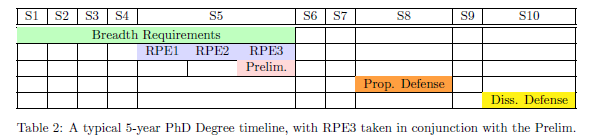
- Table 2 illustrates a typical 5-year PhD timeline, in which the Preliminary Examination is completed in conjunction with the third RPE presentation during the fifth semester (S5). Note that in order to take the Preliminary Examination, the Breadth Requirements have to be completed first. Consequently, in this specific scenario, the Preliminary Examination will not be considered passed until all the final grades in the Breadth Requirements become available, and the Breadth Requirements are satisfied.
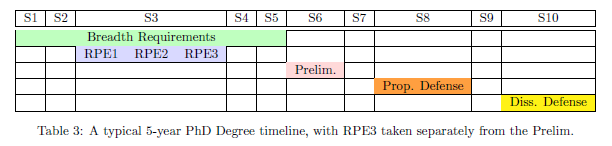
- Table 3 illustrates a typical 5-year PhD timeline, in which the RPE is completed towards the beginning of the program (third semester; S3), and the Preliminary Examination is separate from the RPE. Note that the Preliminary Examination must be completed within one semester of completing the RPE and Breadth Requirements – in this scenario, no sooner than the end of the fifth semester and no later than the sixth semester.
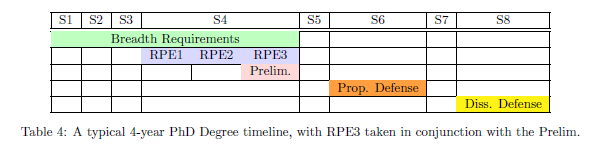
- Table 4 illustrates a typical 4-year PhD timeline. Note that the Breadth Requirements and the RPE are both completed by the end of the fourth semester (S4), and the Preliminary Examination is taken in conjunction with the third RPE presentation (this is a recommended strategy for a 4-year timeline, but it is not the only option).
 .
.
Ph.D. Advising (1/2)
 .
.
Ph.D. Advising (2/2)
 .
.
RPE Form
 .
.